Seyahat · Metin 74
Pamukkale: The Cotton Castle
Pamukkale: Pamuk kale
Bembeyaz travertenler, sıcak su havuzları ve antik Hierapolis. Pamukkale nasıl oluştu, neden çıplak ayakla yürünüyor ve tepedeki oteller neden yıkıldı?
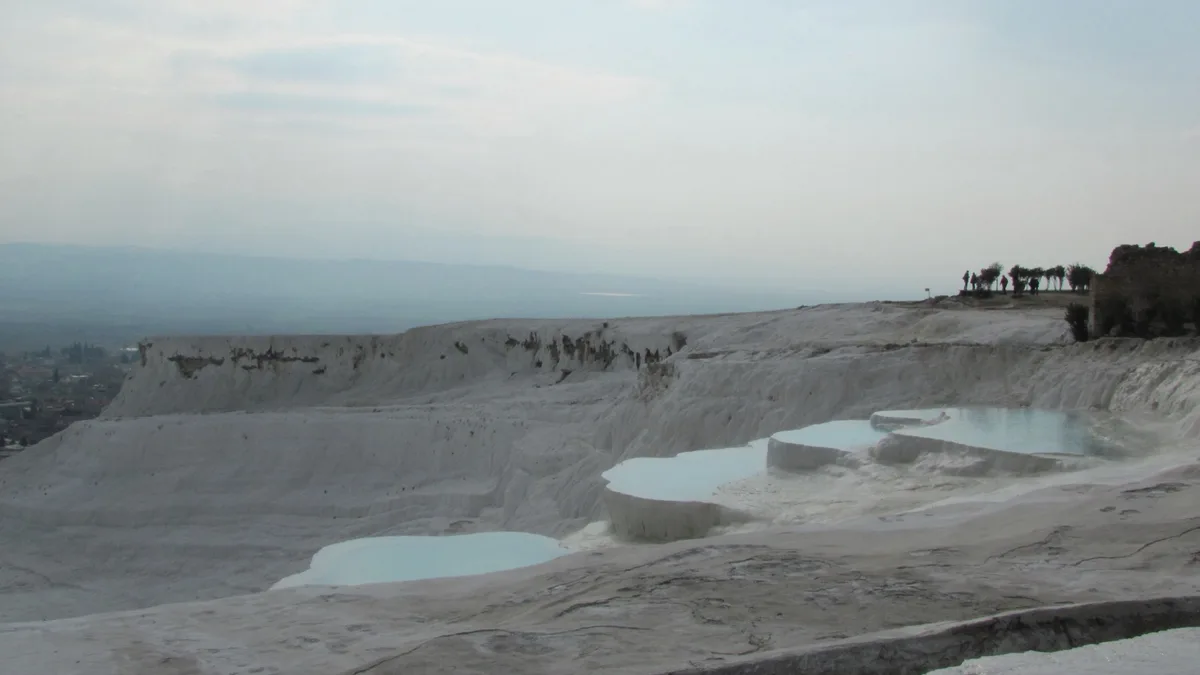
Pamukkale travertenleri · Fotoğraf: Slyronit · CC BY-SA 4.0
Level 1 · Başlangıç · A1–A2
Metni dinle
Altı çizili kelimelere dokun!
Pamukkale is in Denizli, in the west of Turkey. Its name means “cotton castle”. From far away, the looks like it is covered in snow or cotton. But it is not snow. It is white stone.
Pamukkale, Türkiye'nin batısında, Denizli'de. Adı “pamuk kale” anlamına geliyor. Uzaktan bakınca yamaç karla ya da pamukla kaplı gibi görünüyor. Ama kar değil. Beyaz taş.
Warm water comes out of the and flows down the hill. The water has a lot of in it. Over thousands of years, these minerals made white and small .
Yerden ılık su çıkıyor ve tepeden aşağı akıyor. Suyun içinde çok mineral var. Binlerce yıl içinde bu mineraller beyaz teraslar ve küçük havuzlar oluşturdu.
Visitors must take off their shoes and walk with bare feet. This the white stone. The water in the pools is warm and very .
Ziyaretçiler ayakkabılarını çıkarıp çıplak ayakla yürümek zorunda. Bu, beyaz taşı korur. Havuzlardaki su ılık ve çok berrak.
At the top of the hill, there is an old Roman city called Hierapolis. You can see a big theatre and even in an old pool with Roman columns in the water!
Tepenin üstünde Hierapolis adında eski bir Roma şehri var. Büyük bir tiyatro görebilir, hatta suyun içinde Roma sütunları olan eski bir havuzda yüzebilirsin!
Gramer ipucu
look like: -e benzemek
look like + isim/cümle: “… gibi görünmek, -e benzemek”.
Metinden:
the hillside looks like it is covered in snow or cotton
Başka örnekler:
- You look like your mother.Annene benziyorsun.
- It looks like it's going to rain.Yağmur yağacak gibi görünüyor.
Bu metnin kelimeleri
- hillside isim yamaç There are houses on the hillside.
- ground isim yer, zemin The ground is wet after the rain.
- mineral isim mineral This water is rich in minerals.
- terrace isim teras, set They grow rice on terraces.
- pool isim havuz The hotel has a big pool.
- protect fiil korumak Sunglasses protect your eyes.
- clear sıfat berrak, açık The water is so clear you can see the fish.
- swim fiil yüzmek Can you swim?
Anladın mı? Mini quiz
-
What does “Pamukkale” mean?
Pamuk kale.
-
What made the white terraces?
Sudaki mineraller.
-
Why must visitors walk with bare feet?
Beyaz taşı korur.
-
What is Hierapolis?
Eski bir Roma şehri.
Level 2 · Orta · B1
Metni dinle
Altı çizili kelimelere dokun!
Seen from the valley below, the hillside at Pamukkale looks : a bright white , shining in the sun, with layers of pools stepping down it like a giant . The name means “cotton castle” in Turkish, and it is easy to see why.
Aşağıdaki vadiden bakıldığında Pamukkale'deki yamaç gerçek dışı görünüyor: Güneşte parlayan bembeyaz bir yamaç ve dev bir merdiven gibi aşağı inen kat kat havuzlar. Adı Türkçede “pamuk kale” demek ve nedenini anlamak kolay.
The white terraces are made of travertine, a type of stone. Warm water from underground springs, at about 35 degrees, is full of calcium. As the water flows down the slope and cools, the calcium is as a hard white layer. Over thousands of years, these layers built the terraces.
Beyaz teraslar bir taş türü olan travertenden oluşur. Yaklaşık 35 derece sıcaklıktaki yer altı kaynaklarından gelen ılık su kalsiyumla doludur. Su yamaçtan aşağı akıp soğudukça kalsiyum sert beyaz bir tabaka olarak geride kalır. Binlerce yıl boyunca bu tabakalar terasları oluşturdu.
Above the terraces lies Hierapolis, a city founded in the 2nd century BC and later by the Romans. People came here for the waters. Together, Hierapolis and Pamukkale became a UNESCO World Heritage Site in 1988.
Terasların üstünde, MÖ 2. yüzyılda kurulan ve daha sonra Romalılar tarafından yönetilen Hierapolis şehri uzanır. İnsanlar buraya şifalı suları için gelirdi. Hierapolis ve Pamukkale birlikte 1988'de UNESCO Dünya Mirası Alanı oldu.
In the past, hotels were built on top of the terraces, and their pools used much of the water. The white stone started to turn grey. The hotels were later removed, and today strict rules protect the site: you must walk , and some areas are closed to let them .
Geçmişte terasların üstüne oteller yapıldı ve havuzları suyun büyük kısmını kullandı. Beyaz taş griye dönmeye başladı. Oteller daha sonra kaldırıldı ve bugün sıkı kurallar alanı koruyor: Çıplak ayakla yürümek zorundasın ve bazı bölgeler iyileşebilsin diye kapalı.
Gramer ipucu
Seen from …: geçmiş ortaç ile başlangıç
Seen from … (… -den görüldüğünde/bakıldığında) gibi V3 ile başlayan yapılar, ana cümlenin öznesini anlatır.
Metinden:
Seen from the valley below, the hillside at Pamukkale looks unreal
Başka örnekler:
- Seen from space, the Earth looks blue.Uzaydan bakıldığında Dünya mavi görünür.
- Built in 1890, the house is still in good condition.1890'da yapılan ev hâlâ iyi durumda.
Bu metnin kelimeleri
- unreal sıfat gerçek dışı, inanılmaz The colours of the sunset looked unreal.
- staircase isim merdiven The house has a wooden staircase.
- leave behind fiil geride bırakmak I left my umbrella behind in the taxi.
- rule fiil yönetmek, hükmetmek The Ottomans ruled this region for centuries.
- healing sıfat şifalı, iyileştirici People believe the spring has healing powers.
- slope isim yamaç The house stands on a steep slope.
- barefoot zarf çıplak ayakla, yalınayak The children ran barefoot on the beach.
- recover fiil iyileşmek, eski hâline dönmek He is recovering from an operation.
Anladın mı? Mini quiz
-
What is the temperature of the spring water?
Yaklaşık 35 derece.
-
How did the terraces form?
Su soğudukça kalsiyum geride kaldı.
-
Why did people come to Hierapolis?
Şifalı suları için.
-
What happened when hotels used the water?
Taş griye dönmeye başladı.
Level 3 · İleri · B2
Metni dinle
Altı çizili kelimelere dokun!
Approached from the plain below, Pamukkale appears almost : an entire hillside of brilliant white, terraced into scalloped basins of turquoise water. Its Turkish name, “cotton castle”, captures the effect perfectly, but the reality is geological rather than .
Aşağıdaki ovadan yaklaşıldığında Pamukkale neredeyse bir hayal gibi görünür: turkuaz suyla dolu, deniz kabuğu kenarlı havzalara basamak basamak ayrılmış, göz kamaştırıcı beyazlıkta koca bir yamaç. Türkçe adı “pamuk kale” bu etkiyi kusursuzca yakalar, ama gerçeklik hayal ürünü değil, jeolojiktir.
The terraces are composed of travertine, a form of limestone by mineral-rich hot springs. Water emerges from the ground at around 35 degrees, saturated with calcium bicarbonate. As it flows down the slope, carbon dioxide escapes into the air, and calcium carbonate out, coating everything in its path with a soft gel that slowly hardens into stone. The process is ongoing, and in places the formations by millimetres a year.
Teraslar, minerallerce zengin sıcak su kaynaklarının biriktirdiği bir kireç taşı türü olan travertenden oluşur. Su yerden yaklaşık 35 derecede, kalsiyum bikarbonata doymuş olarak çıkar. Yamaçtan aşağı akarken karbondioksit havaya kaçar ve kalsiyum karbonat çökelerek yolundaki her şeyi yavaş yavaş taşa dönüşen yumuşak bir jelle kaplar. Süreç hâlâ devam ediyor ve yer yer oluşumlar yılda milimetrelerle birikiyor.
The springs drew settlers long before tourists. Above the travertines lie the ruins of Hierapolis, founded in the 2nd century BC by the Attalid kings of Pergamon and later a flourishing Roman spa town, complete with a theatre, baths and an enormous . In 1988, the site was inscribed on UNESCO's World Heritage List as Hierapolis-Pamukkale.
Kaynaklar turistlerden çok önce yerleşimcileri çekti. Travertenlerin üstünde, MÖ 2. yüzyılda Bergama'nın Attalos hanedanı krallarınca kurulan ve daha sonra tiyatrosu, hamamları ve devasa nekropolüyle gelişkin bir Roma kaplıca kenti hâline gelen Hierapolis'in kalıntıları uzanır. 1988'de alan, Hierapolis-Pamukkale adıyla UNESCO Dünya Mirası Listesi'ne alındı.
Popularity nearly proved . In the late 20th century, hotels built on the plateau diverted the thermal water into their pools, and parts of the terraces began to dry out and discolour. The hotels were eventually demolished, water flow is now carefully managed, and visitors must walk barefoot on paths, a modest price for preserving one of the world's most remarkable natural monuments.
Popülerlik neredeyse yıkıcı oldu. 20. yüzyılın sonlarında platonun üzerine yapılan oteller termal suyu kendi havuzlarına yönlendirdi ve terasların bazı kısımları kurumaya ve renk değiştirmeye başladı. Oteller sonunda yıkıldı, su akışı artık dikkatle yönetiliyor ve ziyaretçiler belirlenmiş yollarda çıplak ayakla yürümek zorunda; bu da dünyanın en dikkat çekici doğal anıtlarından birini korumak için ödenen mütevazı bir bedel.
Gramer ipucu
rather than ile sıfat karşılaştırması
A rather than B: “B değil, A”. İki sıfatı karşılaştırırken de kullanılır.
Metinden:
the reality is geological rather than whimsical
Başka örnekler:
- The problem is practical rather than technical.Sorun teknik değil, pratik.
- She was tired rather than ill.Hasta değil, yorgundu.
Bu metnin kelimeleri
- hallucinatory sıfat hayal/sanrı gibi The desert lights had a hallucinatory quality.
- whimsical sıfat hayal ürünü, kaprisli, fantastik The book has whimsical drawings.
- deposit fiil biriktirmek, çökeltmek The river deposits mud on the fields.
- precipitate fiil çökelmek Salt precipitates when the water evaporates.
- accumulate fiil birikmek Dust accumulates quickly in this room.
- necropolis isim nekropol, antik mezarlık The necropolis has over a thousand tombs.
- ruinous sıfat yıkıcı, mahvedici The war had ruinous effects on the economy.
- designated sıfat belirlenmiş, ayrılmış Smoking is allowed only in designated areas.
Anladın mı? Mini quiz
-
What is travertine?
Sıcak su kaynaklarının biriktirdiği bir kireç taşı.
-
What happens as the water flows down the slope?
Karbondioksit kaçar ve kalsiyum karbonat çökelir.
-
Who founded Hierapolis?
Bergama'nın Attalos hanedanı kralları.
-
What did the hotels on the plateau do?
Termal suyu kendi havuzlarına yönlendirdi.